You've owned this Stihl strimmer for a while. It's been reliable. Today it needs something. Maybe the trimmer line keeps snapping. Maybe the head won't feed. Maybe the engine starts and dies, or won't fire at all. You've walked out to the machine, jotted down whatever numbers you can read off the ID sticker, and now you want to order the right part without having to repeat the process later in the week.
The FS-series has been Stihl's strimmer and brushcutter line since the late 1970s. The FS 80, launched in 1977, was one of the first proper trimmers. Today the range covers everything from the entry-level FS 38 through to professional clearing saws like the FS 510 C-EM, plus the cordless FSA range and Kombi-compatible FS-KM attachments. The badge is the same, the identification system is the same, and the parts catalogue stretches back decades.
FS stands for Freischneider: German for "free cutter" or "line trimmer". Same Stihl quality, same Stihl 9-digit serial number identification system, same approach to parts.
This guide walks through how Stihl identifies your machine, what fits across the FS range, the trimmer head systems (AutoCut, TrimCut, PolyCut, DuroCut), the five parts most owners replace, and the three best ways to find what you need. The aim is to get you to the right part the first time.
If you'd rather skip the guide and let us identify the part for you, click the Contact Us button at the bottom of any page on the site, send us a photo of your machine's ID sticker, and we'll find it.
How Stihl identifies your machine: the 9-digit serial number
Stihl's identification system is different from the Art.N system that STIGA Group brands (Stiga, Mountfield, Alpina, ATCO, Castel) use. If you've owned a Mountfield or Stiga as well, set that mental model aside. Stihl works differently.
Every Stihl FS-series machine has a 9-digit serial number printed on a silver or white ID sticker somewhere on the body. Examples look like 811925038 or 437315588. This is the number we need to pinpoint the exact production run of your machine and find the right parts diagrams.
Where to find the serial number on your FS-series machine
The sticker is usually on the motor housing. Specifically:
- On the underside or side of the motor casing, near where the drive tube meets the engine
- Sometimes under a removable plastic cover
- On smaller FS machines (FS 38, FS 40, FS 45), often on the rear of the engine housing
- On larger FS machines (FS 250, FS 260, FS 410+), often on the cylinder cover
The same identification system applies across all Stihl handheld petrol kit and across Viking (which is part of the Stihl Group).
If the sticker is faded or missing, the 9-digit serial number is often stamped directly into the crankcase or cylinder as a backup. Look closely, sometimes you need a torch and a clean rag. On older FS-series machines, the stamped number can be partially obscured by oil residue.
For the full reference, see the on-site Model Identification Advice for Stihl and Viking.
What the serial number tells us, and what it doesn't
The 9-digit serial number identifies the exact production run of your machine. Same logic as Stiga's Art.N: even within a single model number (say "FS 56"), there are multiple production runs with small specification differences between them, and the parts diagrams on the site are organised by serial number.
Same model name, different serial number, potentially different parts. The throttle cable for an FS 56 from 2012 is not necessarily the same as the throttle cable for an FS 56 from 2018, even though both machines carry the same model badge.
When ordering parts, the serial number is what matters most. Send us a photo of the ID sticker if you're not sure which production run you have.
Decoding the FS-series model number
Useful background for buyers who are curious about the lettering after the number:
- FS = Freischneider (line trimmer)
- The number indicates the relative position in the range (higher numbers generally mean more power, but not always linearly)
- The letters after the number describe the variant:
- C = Comfort (improved ergonomics, anti-vibration)
- E = Easy2Start (lower-effort recoil starting)
- M or CM = M-Tronic (electronic engine management on higher-end models)
- R = "Rundumgriff" or loop handle (vs bike handle)
- EZ or C-EZ = ErgoStart Easy
- Z = ZipStart (older Easy2Start variant)
So an FS 56 C-E is the comfort variant of the FS 56 with Easy2Start. An FS 131 R has the loop handle. An FS 490 C-EM is the comfort variant with electronic engine management.
The Stihl FS-series range and what fits each tier
The FS-series breaks into three practical tiers based on power, weight and parts compatibility. We've grouped the models accordingly because parts often cross within each tier, much less between tiers.
Entry-level domestic strimmers: FS 38, FS 40, FS 45, FS 50
The everyday garden strimmer. Light, straight-shaft, usually with a loop handle. Designed for trimming lawn edges, working under shrubs, and tidying small areas.
Models in this tier:
- FS 38: the lightest petrol FS, entry point to the range
- FS 40 and FS 40 C-EZ: slightly more capable, the C-EZ adding ErgoStart
- FS 45: one of Stihl's best-selling strimmers ever, widely owned across the UK
- FS 50: slightly heavier-duty domestic kit
Parts characteristics across this tier:
- Use the AutoCut 5-2 or 6-2 trimmer heads (smaller, lighter heads)
- Compatible nylon line: 2.0mm or 2.4mm round
- Spark plug: Champion RCJ7Y on older machines, NGK CMR6H on newer
- Straight-shaft drive tube, generally non-removable
- Loop handle is standard; bike handle uncommon at this tier
Common replacement parts on entry-level FS-series: trimmer heads, nylon line, eyelets, spark plugs, air filters, fuel filters, primer bulbs, recoil starter rope, recoil starter spring.
Browse Stihl Brushcutters parts, check the Stihl Trimmer Head Quick Reference Guide, or send us a photo via the Contact Us button if you're unsure which model you have.
Intermediate FS-series: FS 55, FS 56, FS 70, FS 80, FS 85, FS 86, FS 90, FS 91
The mid-range. Heavier-duty than the entry-level, often used by serious garden owners and semi-professional landscapers. This is the broadest section of the FS family and the one with the most cross-machine parts compatibility.
Models in this tier:
- FS 55: older mid-range, parts still well supported
- FS 56: the modern mid-range workhorse. Multiple variants: standard FS 56, FS 56 C-E, FS 56 C-EZ, FS 56 RC-E
- FS 70: discontinued but still in active use across the UK
- FS 80: one of the original Stihl strimmers from the late 1970s, parts still supported
- FS 85 and FS 86: older mid-range
- FS 90, FS 90 R, FS 91: modern mid-range, often supplied with M-Tronic on higher specs
Parts characteristics across this tier:
- Use the AutoCut 25-2 or 26-2 trimmer heads (the workhorse heads)
- Compatible nylon line: 2.4mm or 2.7mm
- Spark plug: Champion RCJ7Y (older) or NGK CMR6H (newer)
- Bike handle or loop handle, depending on variant
- More extensive parts catalogue than entry-level: clutch assemblies, gear heads, throttle cables, vibration damping mounts, anti-vibration springs
Cross-machine compatibility within this tier is strong. The AutoCut 25-2 head fits a long list of mid-range FS machines. The same trimmer line works across the tier. Many service parts (filters, fuel system components, recoil parts) cross over between FS 56, FS 70, FS 91 and similar mid-range models.
Browse the diagrams: FS 56, FS 56 RC-E, FS 80, FS 86, FS 91.
Professional FS-series: FS 131 R, FS 250, FS 260, FS 410, FS 490 C-EM, FS 510 C-EM, FS 560 C-EM
The heavy end of the range. Built for landscapers, smallholders, professional grounds-maintenance contractors and anyone doing significant daily volumes of work.
Models in this tier:
- FS 131 R: strong domestic-to-pro crossover model
- FS 250: long-standing professional brushcutter
- FS 260, FS 260 C-E: current heavy-duty
- FS 410: professional petrol
- FS 490 C-EM, FS 510 C-EM, FS 560 C-EM: top-tier professional with M-Tronic electronic engine management
Parts characteristics across this tier:
- Larger trimmer heads: AutoCut 36-2, 46-2, 56-2, plus PolyCut and DuroCut alternatives for heavy vegetation
- Thicker nylon line: 2.7mm, 3.0mm, sometimes 3.3mm
- Often supplied with metal blade attachments alongside trimmer heads (for brush, scrub, light timber)
- M-Tronic models have specific electronic components (ignition modules, sensors) that the older mechanical models don't have. Parts are not interchangeable between M-Tronic and non-M-Tronic versions of the same model number.
- Higher-cost parts overall: clutch assemblies, gear heads, drive shafts, full electrical looms
Browse the FS 131 R diagrams, the FS 250 diagrams, or send a photo via Contact Us for FS 260+ models.
How the Stihl Kombi system relates to your FS-series
A short but important section because some buyers reach the strimmer parts page when they're actually looking for KombiTool parts.
Stihl's Kombi System is a separate but related product line. Instead of buying a dedicated FS-series strimmer, you buy a KombiEngine powerhead (KM 55, KM 56, KM 90 R, KM 91 R, or KM 130 R) and pair it with one or more interchangeable KombiTool attachments: trimmer, brushcutter, hedge trimmer, pole pruner, edger, blower, cultivator, and so on.
The strimmer attachment is the FS-KM Gear Head. This is not the same thing as a complete FS-series strimmer. It's the cutting head and gear assembly that bolts onto your KombiEngine, with a drive tube and trimmer head.
Why this matters when ordering parts:
- Many KombiEngine parts cross over to FS-series machines of similar age and class. Spark plugs (NGK CMR6H fits both KM 55 and most FS-series), air filters, primer bulbs, fuel system components and recoil parts often interchange.
- The FS-KM Gear Head shares trimmer heads with FS-series machines. AutoCut 25-2 and 26-2 fit both Kombi strimmer attachments and equivalent FS-series machines.
- The drive tube assembly is different. Kombi tubes have a coupling that lets attachments swap out. FS-series tubes are fixed.
If you've got a Kombi setup and you've searched for "FS strimmer parts", you're not far off. But you'll want to confirm whether you need an FS-series part or an FS-KM Gear Head part before ordering. Send a photo via Contact Us if you're unsure.
Browse the Stihl Kombi System parts or the FS-KM Gear Head diagrams.
Stihl trimmer heads explained: AutoCut, TrimCut, PolyCut, DuroCut
This is the most useful single section of the article because trimmer heads are the number one wear part on any strimmer, and Stihl's system is well-engineered but not always well-explained at the point of sale.
Stihl makes four main types of trimmer head, each suited to different conditions and different machines.
The four head types and what they're for
AutoCut is the bump-feed head. Line releases automatically when you tap the head on the ground while it's spinning. Self-adjusting, low-maintenance, fitted as standard to most FS-series machines from the factory. The most popular choice for general use.
TrimCut is semi-automatic. You manually pull line out to length when you need more, by stopping the machine and pulling. Simpler internal mechanism, more durable, fewer parts to break. Preferred by some professional users who don't want to rely on the bump-feed system.
PolyCut uses three plastic blades instead of nylon line. Better for tougher vegetation: woody stems, dense weeds, light brush that would tangle and snap nylon line. Blades replace individually when worn. Not suitable for hard objects like stones or fences.
DuroCut uses pre-cut line segments rather than a continuous spool. Line clips in as fixed-length pieces, replaced one segment at a time. Heavy-duty, professional use, where the line takes a lot of impact and a continuous spool would just shred.
Which head fits which FS-series machine
The fitments correlate with the tiers above:
- AutoCut 5-2 and 6-2: fit the entry-level tier: FS 38, FS 40, FS 45, FS 46, FS 50
- AutoCut 25-2 and 26-2: fit the intermediate tier: FS 55, FS 56, FS 70, FS 91, FS 94, FS 111, FS 131, FS 240
- AutoCut 36-2, 46-2, 56-2: fit the professional tier: FS 260, FS 410, FS 490 and above
TrimCut, PolyCut and DuroCut equivalents follow the same fitment logic: the head size is matched to the machine's power class.
For the full reference, including all trimmer head types and their compatibility with the wider Stihl range, see the on-site Stihl Trimmer Head Quick Reference Guide. It includes Stihl's official how-to videos for fitting and loading each head type. For FS-series owners, it's the single most useful resource on the site.
When to replace a trimmer head (rather than just replacing the line)
Replace the line when:
- It snaps unusually frequently
- It feeds inconsistently or in clumps
- It feels brittle in your hands (line can perish if the spool has been sitting unused for months in a warm shed)
Replace the whole head when:
- The housing is cracked
- The bump knob is broken, stuck, or won't depress
- The eyelets (where the line feeds out) are worn smooth or chipped
- The head no longer feeds line correctly even with fresh line and the correct loading method
Line is inexpensive. Heads last for years if you replace the line regularly and replace the eyelets at the first sign of wear. Most "I need a new head" cases are actually "I need new eyelets" cases.
Browse the Stihl Trimmer Heads parts group, the cross-brand trimmer heads category, or the trimmer line category.
The five FS-series parts most owners replace
Across years of stocking parts for Stihl FS-series owners, the same five categories come up repeatedly. They're not faults: they're normal wear and consumable items.
1. Trimmer line
The single most common consumable on any FS-series machine. Line wears down through normal use, snaps on hard objects (stones, fences, tree roots), and degrades over time even when unused.
Most Stihl FS-series machines take 2.4mm round line as their standard, but the right diameter depends on your machine:
- 1.5mm to 2.0mm: Electric/battery FSA models, or very small petrol FS (FS 38, FS 40 in some configurations)
- 2.4mm: Most FS 45, FS 50, FS 56, FS 70 machines
- 2.4mm to 2.7mm: Mid-range FS 80, FS 91, FS 131
- 2.7mm to 3.0mm: Larger FS 250, FS 260
- 3.0mm to 3.3mm: Heavy-duty FS 410, FS 490, FS 510
Line shapes vary as well as diameters. Round line is the general-purpose choice. Square line cuts cleaner edges but wears faster. Twisted line runs with less vibration and lasts longer. Serrated line is more aggressive on tough vegetation.
Browse the full trimmer line category.
2. Trimmer heads, spools and eyelets
After line, the head itself is the next most-replaced item. Spools wear from line feeding through them. Eyelets get smooth from the line passing across them. Bump knobs break from being tapped on hard ground.
Often you can replace just the spool (a cheap fix) or just the eyelet pair (cheaper still) rather than the whole head. The decision flow is in the previous section above.
Browse Stihl Trimmer Heads for the full range.
3. Spark plugs
The single most commonly replaced engine service part. Spark plugs should be replaced annually as part of a normal service, or sooner if you've had starting problems or rough running.
Two fitments cover most FS-series machines:
- NGK CMR6H (Stihl part
0000 400 7011, around £4): the standard plug for modern Stihl 2-MIX petrol kit, including most current FS-series machines - Champion RCJ7Y: older FS-series machines and other older Stihl handheld kit
If you're unsure which one your machine takes, check the engine code on the ID sticker or send us a photo. Browse Stihl spark plugs.
4. Air filters, fuel filters and engine service kits
Routine service items. Both should be checked annually and replaced when contaminated or damaged.
A clogged air filter robs the engine of power, increases fuel consumption, and makes the strimmer run rough. A clogged fuel filter starves the carburettor and causes intermittent running or stalling under load.
The simplest way to handle annual service is to buy a maintenance kit (also called an engine service kit), which bundles the air filter, fuel filter, spark plug and sometimes oil into a single product for a specific machine.
Browse the Engine Service Kits category, which includes kits for many of the FS-series machines.
5. Recoil starter ropes, springs and primer bulbs
The pull-start mechanism is one of the most-used parts of any petrol strimmer, and the rope, spring and primer bulb are the most common starting-system failures.
Three failure modes:
- Rope snaps: usually after many years of pulling. Replacement is cheap and straightforward.
- Spring loses tension: the rope doesn't retract properly. Replacement is fiddly but cheap.
- Primer bulb cracks or perishes: the bulb won't hold pressure, so the carburettor can't be primed for cold starts. This is one of the most common "why won't this start" causes on older FS-series machines, and the bulb is typically a £5 part.
All three are inexpensive but the strimmer doesn't start until they're replaced.
Three ways to find the right Stihl FS-series part
Three routes. For FS-series owners, the Quick Reference Guides are usually the fastest answer.
Option 1: Start with the Stihl Quick Reference Guides
Three on-site guides cover most FS-series questions faster than browsing diagrams.
The Stihl Trimmer Head Quick Reference Guide is the most comprehensive reference for the FS range. It covers AutoCut, TrimCut, PolyCut and DuroCut systems with fitments, recommended line sizes, and Stihl's official how-to videos for fitting and loading each head type. For any consumables question on an FS-series machine, start here.
The Stihl Combination Wrench Quick Reference Guide covers the right service wrench for each machine in the FS-series and the wider Stihl range. Worth knowing if you're servicing the machine yourself.
The Model Identification Advice for Stihl and Viking explains the 9-digit serial number system and where to find it on different machines.
For most FS-series questions, one of these three guides has the answer.
Option 2: Browse the interactive parts diagrams
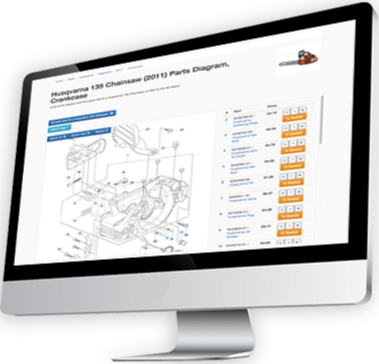
For specific internal component identification, the interactive diagrams are the next step. Every FS-series machine on the site has its own diagram set, with exploded views by assembly: engine, ignition, drive tube, gear head, controls, fuel system, carburettor, clutch.
Start at the Stihl Brushcutters parts group, pick your model, select the year or serial number range that matches your machine, then browse the diagrams page by page. Every component is numbered and the part number is listed alongside.
Best for: identifying a specific internal component (a clutch part, a carburettor diaphragm, a crankshaft bearing) rather than a routine consumable like line or a head.
Option 3: Send a photo via the Contact Us button
The free part identification safety net. For anything still uncertain after the first two routes: missing ID sticker, an older FS-series model where the diagrams are dense, a cross-fitment question, or a part that's been superseded.
Click the Contact Us button at the bottom of any page on the site, send a photo of your machine's ID sticker plus a description of the part you need, and we'll find it.
A few things worth knowing:
- We sell genuine OEM Stihl parts only. No aftermarket copies. The part you receive is what a Stihl dealer would supply.
- We ship worldwide on a tracked service from our warehouse in Shaftesbury, Dorset. Stihl FS-series parts go regularly to the US, Canada, Australia, New Zealand, Ireland and across Europe.
- The team has stocked Stihl parts since the company was founded in 2012. Stihl is the largest single brand on the site by sales volume.
Common questions FS-series owners ask
Which spark plug does my Stihl FS strimmer take?
Most modern FS-series machines (broadly 2010 onwards) take NGK CMR6H (Stihl part 0000 400 7011, around £4). Older FS-series machines (pre-2010) typically take Champion RCJ7Y. If you're not sure, check your machine's serial number against the parts diagram on the site, or send a photo via Contact Us.
What size trimmer line does my FS-series machine need?
Depends on the model. As a rough guide:
- FS 38, FS 40, FS 45, FS 50: 2.0mm or 2.4mm
- FS 55, FS 56, FS 70, FS 80, FS 91: 2.4mm or 2.7mm
- FS 131 R, FS 250, FS 260: 2.7mm or 3.0mm
- FS 410, FS 490, FS 510, FS 560: 3.0mm or 3.3mm
Always check your machine's manual first. The recommended line diameter is usually printed on the deflector guard or in the handbook. Going thicker than the recommended size puts extra strain on the engine.
Which trimmer head fits my FS-series machine?
The on-site Stihl Trimmer Head Quick Reference Guide is the definitive answer. Generally:
- Entry-level FS 38 to FS 50: AutoCut 5-2 or 6-2
- Mid-range FS 55 to FS 91: AutoCut 25-2 or 26-2
- Larger FS 131 R and above: AutoCut 36-2, 46-2 or 56-2
The same fitment tiers apply for TrimCut, PolyCut and DuroCut equivalents.
Can I use non-Stihl trimmer heads on my FS-series strimmer?
In most cases we don't recommend it. Stihl trimmer heads are designed specifically for Stihl machines, with the correct thread, the correct drive interface, and balanced for the gear head. Third-party heads exist and some claim Stihl compatibility, but fitment isn't guaranteed and using non-OEM parts may affect any remaining warranty.
If you've already got a non-OEM head and it's not working, an OEM Stihl replacement is usually the fastest fix.
How old is my Stihl FS strimmer, and can I still get parts?
Yes, in most cases. Stihl has excellent parts availability going back decades. Even FS 80 machines from the late 1970s and early 1980s still have many parts available. The 9-digit serial number on the ID sticker tells us the production run, and we can identify what's currently in stock or what equivalent parts will fit if the original has been superseded.
What does "FS" stand for?
Freischneider. German for "free cutter" or "line trimmer". All Stihl strimmers and brushcutters use the FS designation. The cordless equivalents use FSA (with the A for "Accumulator" / battery). The model number after the letters indicates the size and power class.
Why won't my FS-series strimmer start?
Most non-starting issues come down to a small list of causes, in rough order of frequency:
- Stale or contaminated fuel (most common cause on machines that have sat unused for months)
- Fouled or worn spark plug
- Clogged air filter restricting airflow
- Clogged fuel filter restricting fuel supply
- Perished primer bulb that won't hold pressure
- Broken recoil starter rope so the engine can't be turned over
All six are inexpensive parts and most owners can replace them at home. If you've worked through the list and the machine still won't start, the next step is to check the ignition coil and the carburettor, which are bigger jobs.
Do you ship Stihl parts outside the UK?
Yes. We ship worldwide on a tracked service, excluding sanctioned territories. We regularly ship Stihl FS-series parts to the US, Canada, Australia, New Zealand, Ireland and across Europe. Shipping rates and delivery times are calculated at checkout once you've added a part to the basket and entered your delivery address.
The FS-series is one of the longest-running Stihl product lines and one of the easiest to keep running over decades. The parts catalogue covers everything from the FS 80 in 1977 through to the current heavy-duty professional models. Three things to remember when ordering: the 9-digit serial number on the ID sticker pinpoints the exact production run and that's the number that matters; trimmer heads, line, plugs and filters are mostly cross-machine within each tier of the range; and the on-site Stihl Trimmer Head Quick Reference Guide answers most consumables questions faster than any diagram. If you're stuck, the Contact Us button is at the bottom of every page on the site, including this one.