Your Stihl disc cutter earns its living, and when it's down, so are you. A TS that won't start, won't hold revs, or is chewing through belts is time off the job, so you want the right part first time rather than a second trip and a second wait.
A quick note on names before we start, because it trips people up. The Stihl TS range gets called a few different things: disc cutter, cut-off saw, and Stihl's own term, the Cutquik cut-off machine. They all mean the same tool, the petrol saw with a spinning abrasive or diamond wheel that cuts concrete, stone, paving, ductile pipe and steel. We'll use disc cutter and cut-off saw interchangeably through this guide, because that's how the trade does.
Whatever you call it, the parts that wear on one are specific to this kind of work, and they're different from anything on a chainsaw or a strimmer: cutting wheels, drive belts, the water system, and above all the air filtration, which on these machines has to cope with the dustiest cutting there is.
This guide covers how to identify your machine, how to choose the right cutting wheel (the part people most often get wrong), and the wear parts a working TS gets through. If you already know what you need, the Stihl parts diagrams will take you to it. If you're not certain, send us a photo and we'll sort it, free of charge.
Which TS model do you have?
The TS range covers a spread of models, and knowing which one you've got is the starting point for every part on it.
The current and recent machines you'll find on the site include the TS 400, TS 410, TS 420 and TS 460, along with the larger TS 700 and TS 800, and the older TS 350 and TS 360 that are still going strong on plenty of sites.
The most common by a distance are the TS 410 and TS 420. They're effectively the same machine in two wheel sizes: the TS 410 takes a 300mm (12") wheel, the TS 420 takes a 350mm (14") wheel and cuts up to around 125mm deep. Because they share so much, many parts cross between them, but not the wheel and not the guard, so the distinction matters when you order.
One more thing worth knowing on the TS 420 in particular: it exists as two variants on the diagrams, the TS 420 A and the TS 420 Z, which differ in the starter setup. If you're ordering starter parts, check which one you've got. For most other parts they share the same components.
The model name is printed on the machine. If you can see it, you're ready to find parts. If you can't, the next section covers where to look.
How to identify your Stihl disc cutter
Like every Stihl machine, your TS carries a serial number that pins down the exact production version, which matters when a part changed partway through a model's life.
The serial number is on the machine's identification details, typically stamped or printed on the motor housing. On a working machine caked in concrete dust and slurry it can be hard to read, so wipe the area down and look again with a torch before assuming it's gone.
You need two things to order confidently: the model (TS 410, TS 420, and so on) and the serial number. The model gets you to the right diagram set, the serial confirms which version within it. If the machine has lost its markings entirely, which happens on hard-worked kit, click the Contact Us button at the bottom of any page, send a photo of the machine and whatever you can read, and we'll identify it.
Choosing the right cutting wheel
The cutting wheel is the part disc cutter owners buy most, and the one where the wrong choice is most obvious: a wheel meant for steel will barely touch concrete, and a wheel meant for concrete will wear away fast and dangerously on steel. Three things decide which wheel you need.
Abrasive or diamond
Abrasive (composite) wheels are the cheaper option and the one most saws are supplied with. They cut well, but they wear down as they cut, so the wheel gets smaller with use and eventually needs replacing. Good for occasional cutting and for jobs where you'd rather spend less per wheel.
Diamond wheels cost more up front but last far longer, hold their diameter, and cut faster and cleaner. For anyone cutting regularly, a diamond wheel usually works out cheaper over its life and saves time on the job. Diamond wheels are matched to the material, so there are different wheels for concrete, for asphalt, for stone and for ductile materials.
The right wheel for the material
Cutting wheels are made for specific materials. A wheel for concrete and stone is built differently from one for steel and metal. Using the wrong one is slow at best and unsafe at worst, so match the wheel to what you're actually cutting. If you cut a mix of materials, it's usually worth keeping more than one wheel to hand rather than forcing one wheel to do everything.
The right size and bore
The wheel has to match your machine on two measurements: the diameter and the centre bore. A TS 410 takes a 300mm wheel, a TS 420 takes a 350mm wheel, and the larger TS 700 and TS 800 take bigger wheels again. The bore (the hole in the centre that fits the spindle) is 20mm on the TS 410 and TS 420, so a 350mm x 20mm wheel is the standard fit for a TS 420. Fitting a wheel of the wrong diameter or the wrong bore is dangerous and won't run true.
If you're unsure which wheel suits your machine and your material, send us your model and what you're cutting and we'll point you to the right one.
The parts a working TS gets through
Disc cutters wear differently from other machines because of the dust, the load and the hours. These are the parts that come up most.
1. Cutting wheels
The obvious consumable, covered in full above. Abrasive wheels in particular are a regular repurchase, so it's worth ordering ahead rather than running out mid-job.
2. Drive belts, tensioners and bearings
The belt drives the wheel, and on a cut-off saw it takes a heavy, dusty load. Belts stretch, glaze and eventually fail. Stihl fitted semi-automatic belt tensioning to the TS 410 and TS 420 to keep belt tension consistent and extend belt and bearing life, but the belt is still a wear part and the tensioner and shaft bearings wear too. If the wheel is slowing under load or the belt is squealing, the belt and tensioner are the first place to look.
3. Air filters
This is the big one on a disc cutter. No machine works in more dust, and a blocked air filter is the fastest route to a poorly running or damaged engine. Stihl's X2 air filtration system with cyclone pre-separation is designed to spin the heavy dust out before it reaches the filter, so the filters last far longer than on an ordinary machine, up to a year depending on conditions. But they do still need replacing.
The TS 410 and TS 420 share an air filter kit (Stihl part 4238-140-4404, which also fits the TS 440, TS 480i and TS 500i). Keeping a spare filter set on the van is cheap insurance against a dust-related breakdown. Browse air filters and engine service kits.
4. The water system
Wet cutting suppresses dust, which protects both your lungs and the machine, and it's a requirement on many sites. The water kit (the connection, shut-off valve, quick connector and the delivery to the wheel guard) has parts that wear, block or get knocked off on a busy site. If your dust suppression has stopped working, it's usually a cheap water-system part rather than anything major.
5. Starter, carburettor and engine service parts
The usual two-stroke wear items apply. The ElastoStart starter handle, recoil rope and spring take a beating. Fuel lines perish with modern ethanol-blended fuel and are a common cause of poor running on older machines. The IntelliCarb carburettor and its diaphragms and gaskets wear over time. Spark plugs, fuel filters and the decompression valve all feature in routine servicing.
Browse spark plugs, fuel filters, and the model diagrams for carburettor and starter parts.
Three ways to find the right TS-series part
Option 1: Use the interactive parts diagrams
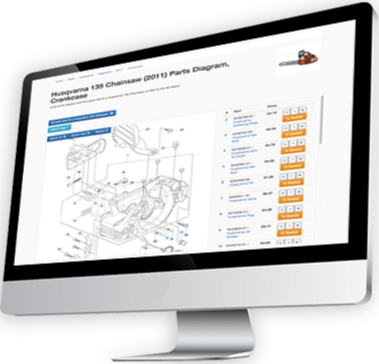
The main route. Every TS machine we support has its own set of exploded diagrams: engine, carburettor, air filtration, belt drive, wheel guard, water attachment, starter. Every part is numbered and priced.
Start at the Stihl parts hub, choose your TS model, and select the diagram set that matches your machine. Best when you know your model and want to identify a specific component.
Option 2: Check the Stihl Quick Reference Guides
The Help and Advice library covers model identification and service parts. Worth a look to confirm a specification before you order.
Option 3: Send us a photo via the Contact Us button
The free identification service. Click Contact Us at the bottom of any page, send a photo of the machine's serial number and a description of the part or the fault, and we'll find it. Free, no obligation, whether or not you've ordered before.
Best for a machine that's lost its markings, a wheel-fitment question, or a part that's been superseded. A couple of things worth knowing:
- We supply genuine OEM Stihl parts only, the same parts a Stihl dealer would fit.
- We ship worldwide on a tracked service from our warehouse in Shaftesbury, Dorset. Two-stroke oil and other liquids can't be sent by air to some countries, so check first if you're ordering from overseas.
Common questions disc cutter owners ask
Is a disc cutter the same as a cut-off saw?
Yes. Disc cutter, cut-off saw and Stihl's own term Cutquik cut-off machine all describe the same tool: the petrol saw with a spinning wheel used for cutting concrete, stone, paving and steel. Different people and different trades use different names for it, but it's one machine.
What's the difference between the TS 410 and the TS 420?
Mainly the wheel size. The TS 410 takes a 300mm (12") wheel, the TS 420 takes a 350mm (14") wheel and cuts deeper. They share a great deal mechanically, including the air filter kit, so many parts cross between them. The wheel and the guard do not, so order those to your specific model.
What size cutting wheel does a TS 420 take?
A 350mm (14") wheel with a 20mm bore. The TS 410 takes a 300mm wheel, also with a 20mm bore. Whether you fit an abrasive or a diamond wheel, it needs to match both the diameter and the bore for your machine.
Should I buy an abrasive or a diamond cutting wheel?
Abrasive wheels are cheaper per wheel but wear down as they cut and need replacing more often. Diamond wheels cost more up front but last much longer, hold their size and cut faster, so for regular use they usually work out cheaper over time. Match either type to the material you're cutting and to your machine's wheel size and bore.
Which air filter does my TS 420 take?
The TS 410 and TS 420 use the same air filter kit (Stihl part 4238-140-4404), which also fits the TS 440, TS 480i and TS 500i. Given how much dust these machines work in, it's worth keeping a spare on hand.
My disc cutter is bogging down under load. What's wrong?
Common causes are a worn or glazed drive belt, a clogged air filter, or a fuel-delivery problem (fuel filter, fuel line or carburettor). On a dusty machine the air filter is the first thing to check. The belt is the next. Both are inexpensive parts.
The water attachment has stopped working. Is that a big job?
Usually not. The water system is made up of the connection, valve, quick connector and delivery parts, and a failure is normally a blocked or damaged component rather than anything serious. Send us your model and we'll identify the part.
Can I still get parts for an older TS 350 or TS 360?
In most cases, yes. These older cut-off saws are well supported, and many parts are still available. Send us the model and serial and we'll tell you what we can supply.
Do you ship TS-series parts outside the UK?
Yes, worldwide on a tracked service. The exception is liquids: two-stroke oil and similar can't be sent by air to some countries, including Australia and New Zealand. Cutting wheels, belts, filters and engine parts ship fine. If in doubt, ask before you order.
A TS is a working tool, and keeping one running comes down to a short list of wear parts and getting the wheel right for the job. Read the model and serial off the machine, match the cutting wheel to your material and your machine (right diameter, right bore), and if anything is unclear the Contact Us button is at the bottom of every page, including this one. Send a photo and we'll get you the right part so you can get back on the job.