Your Stihl chainsaw has stopped doing what it should. Maybe it won't start, maybe the chain has stretched or gone blunt, maybe it's cutting in a curve, maybe something has finally worn out after years of hard use. You've had your money's worth out of it, and now you need a part to keep it going.
The good news is that Stihl's MS-series is one of the best-supported chainsaw ranges in the world for spare parts, and the machine you own was almost certainly built to be repaired rather than thrown away. The part you need is very likely still available.
The one thing that trips people up is getting the identification right, because a chainsaw part that's close but not exact is worse than useless: a chain of the wrong pitch won't run, a bar of the wrong mount won't fit, a piston kit for the neighbouring model won't seal. This guide walks through how to identify your saw properly, which parts wear out and when, and the single most common mistake people make when ordering chain.
If you already know your model and what you need, the Stihl parts diagrams will take you straight to it. If you're not sure, send us a photo of the saw and we'll identify it for you, free of charge.
How to identify your Stihl chainsaw
Stihl chainsaws carry two numbers permanently marked into the body of the saw, and between them they tell you everything you need to order parts.
The serial number and the model number
The model number is the one you probably already know: MS 250, MS 170, MS 261, and so on. It's usually printed on the side of the saw or moulded into the housing. It gets you to the right family of diagrams.
The serial number is stamped or printed into the saw body, and it pins down the exact production version of your machine. On most MS-series saws you'll find it on the top of the saw body, on a flat surface just to the right of the muffler, or on the upper part of the case near the front. On older metal-cased saws it's stamped into the metal. On newer plastic-cased saws it's often dot-printed into the plastic. It can be on either side, so check both.
The serial is purely numeric, anywhere from four to nine digits depending on the age of the saw. You may see a letter in front of it (X, E, F or an underscore). That prefix isn't part of the number, so ignore it when you're reading the serial off.
Between the model number and the serial, we can identify the exact parts diagram set for your saw. If you can read both off the machine, you're most of the way to the right part already.
What if the numbers are worn or the saw is filthy
Chainsaws live hard lives. The serial number sits in exactly the part of the saw that collects bar oil, sawdust and grime, so a number that looks gone is often just dirty. Before you give up, wipe the area down with a rag and a little degreaser and look again with a torch, ideally at an angle so the stamped digits catch the light.
If it's genuinely unreadable, or the saw has had a replacement housing at some point, click the Contact Us button at the bottom of any page and send us a photo of the whole saw plus anything you can read off it. Tell us roughly how old it is and where you bought it. We identify saws from photos all the time.
Which MS-series saw do you have?
The MS range spans everything from a light garden saw to a professional felling saw, and the parts change character as you go up the range. Knowing roughly where your saw sits helps you understand what you're dealing with.
Homeowner and occasional-use saws
The MS 170, MS 180, MS 181, MS 210, MS 211, MS 230 and MS 250 are the domestic backbone of the range. Light, affordable, designed for firewood, storm clearance and general property work rather than all-day use.
These are the saws we're asked about most, and parts availability is excellent. Common jobs: chains and bars, spark plugs, air filters, fuel and oil lines (which perish with age and ethanol in modern fuel), recoil starters, and chain sprockets.
Browse the diagrams for the MS 170, MS 250 and MS 251, or start from the Stihl parts hub and pick your model.
Mid-range and farm-and-ranch saws
The MS 250, MS 261, MS 271, MS 290, MS 291 and the older 025, 026 and 029 sit in the middle: more power, more durable, built for people who use a saw regularly rather than occasionally. The MS 271 in particular is one of the most popular saws we support.
Parts in this tier are heavier-duty and the range is wider: as well as the usual service items you're into clutches, oil pumps, chain tensioners, AV (anti-vibration) mounts and the ignition system.
Browse the MS 271, MS 290 and MS 261 diagrams.
Professional saws
The MS 311, MS 362, MS 390, MS 391, MS 361 and the big felling saws like the MS 660 are built for people who cut for a living. High output, full-profile chains, and parts to match.
On these saws the identification really matters, because several models look similar but use different pistons, cylinders and chain specifications. If you're ordering top-end engine parts for a professional saw, it's worth confirming the exact model against the serial before you buy.
Browse the MS-series diagrams from the Stihl hub, or send us the serial and we'll confirm the diagram set.
How to choose the right chain, and the mistake almost everyone makes
Chain is the part MS-series owners buy most, and it's also the part people most often get wrong. It's worth getting right, because the wrong chain either won't fit or won't cut safely.
Every chainsaw chain is defined by four measurements, and all four have to match your saw and bar:
- Bar length: the cutting length, usually 14, 16, 18 or 20 inches on MS-series saws. It's printed on the side of the bar.
- Pitch: the spacing of the drive links, measured as the distance between three rivets divided by two. This is the critical one, explained below.
- Gauge: the thickness of the drive links where they sit in the bar groove, commonly .050" or .063" on Stihl saws.
- Drive link count: the number of drive links in the loop, which depends on your bar length and pitch.
Here's the mistake. Stihl's homeowner saws (MS 170, MS 180, MS 181, MS 230, MS 250) mostly run 3/8" Low Profile chain, usually written 3/8" LP or PICCO. The bigger professional saws (MS 311, MS 362, MS 391, MS 660) run full 3/8" chain. Those two sound almost identical, and people assume a 3/8" chain is a 3/8" chain.
It isn't. 3/8" LP and full 3/8" are not interchangeable. The cutter profile is different and, more importantly, they run on different drive sprockets. Put a full 3/8" chain on a saw built for 3/8" LP and the chain won't seat on the sprocket properly: it can slip, jump off, or snap. Mid-range saws add a third option, .325", into the mix, and a few very large logging saws use .404".
The safe way to get it right every time is to read the pitch and gauge off your existing chain or bar, or to check the parts diagram for your exact model, which lists the correct specification. If you're at all unsure, send us your model and serial and we'll confirm the right chain before you order.
Browse chainsaw chain, guide bars, and chain sharpening and filing equipment.
The parts MS-series owners replace most
These are the wear items. Not faults, just the things that go on a saw that's used.
1. Chains and guide bars
The chain is a consumable. It dulls with use, and it dulls fast the moment it touches soil, grit or a hidden nail. Regular sharpening extends its life a long way, but eventually the cutters are filed down past their usable depth and the chain needs replacing.
The bar wears more slowly, but it does wear. The rails spread, the nose sprocket seizes, or the bar develops a burr and the saw starts cutting in a curve. A worn bar chews through chains faster, so if you're getting through chains quickly, check the bar.
See the chain-fitment section above before ordering, and browse chains and bars.
2. Drive sprockets
The sprocket drives the chain, and it wears into a stepped profile over time. A worn sprocket won't engage a new chain cleanly, which makes the chain run rough and wear out early. The rule of thumb is to replace the sprocket every second or third chain. If you're fitting a new chain, it's worth checking the sprocket at the same time.
3. Spark plugs
The most-replaced service part on any petrol saw, and the good news is that almost the entire MS petrol range uses the same plug. The standard fitment is the NGK BPMR7A (equivalent to Bosch WSR6F or Champion RCJ7Y, Stihl part 1110 400 7005), which covers the MS 170, MS 180, MS 250, MS 261, MS 290, MS 291, MS 311, MS 361, MS 362 and many more.
Replace it annually as part of a service, or sooner if the saw is hard to start, misfiring or idling roughly. Browse Stihl spark plugs.
4. Air filters, fuel filters and fuel lines
A chainsaw's air filter clogs with fine sawdust faster than almost any other garden machine, and a clogged filter robs power and richens the mixture. It should be cleaned regularly and replaced when it can't be cleaned any more.
Fuel filters (the small filter inside the tank on the end of the pickup line) clog over time and starve the carburettor. Fuel and oil lines are a particular issue on older saws: modern ethanol-blended petrol perishes rubber lines, and a cracked fuel line is one of the most common reasons an older saw won't run right. All of these are inexpensive parts.
Browse air filters, fuel filters and engine service kits, which bundle the common service parts for your model.
5. Recoil starters, clutches and oil pumps
The recoil starter takes a beating and the rope eventually snaps or the spring loses tension. The clutch wears, particularly on saws that have done a lot of work, and worn clutch shoes stop the chain driving properly. The oil pump and worm drive can fail, which shows up as a bar that isn't getting oil (a serious problem, because a dry bar destroys chains and bars quickly).
All are available across the MS range. If your saw has stopped oiling the bar, don't keep cutting: check the oil pump, the worm drive and the oil lines before you do any more damage.
Three ways to find the right MS-series part
Option 1: Use the interactive parts diagrams
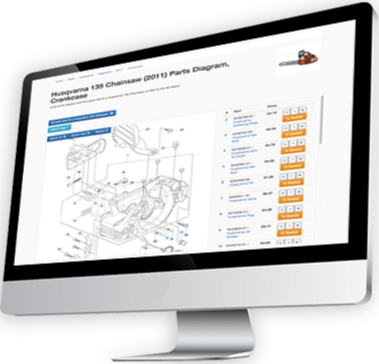
The main route. Every MS-series saw we support has its own set of exploded diagrams: engine, ignition, fuel system, chain and bar, handle, oiling system. Every component is numbered and priced.
Start at the Stihl parts hub, choose Chainsaws, pick your model, then select the diagram set that matches your saw. Work through the diagrams to find your part. This is the best route when you know your model and want to identify a specific component visually.
Option 2: Check the Stihl Quick Reference Guides
The Help and Advice library holds quick reference guides on model identification, spark plug fitment and service parts. If you want to confirm a specification before you order, particularly a chain or a plug, start there.
Option 3: Send us a photo via the Contact Us button
The free identification service. Click Contact Us at the bottom of any page, send a photo of your saw's serial number and a description of the part or the fault, and we'll find it for you. Free, no obligation, and you don't need to have bought from us before.
Best for a worn serial number, an older saw, a chain-fitment question you want double-checked, or a part that's been superseded. A couple of things worth knowing:
- We supply genuine OEM Stihl parts only, the same parts a Stihl dealer would fit.
- We ship worldwide on a tracked service from our warehouse in Shaftesbury, Dorset. Note that chainsaw bar oil and two-stroke oil can't be shipped to some countries by air, so check first if you're ordering from overseas.
Common questions MS-series owners ask
Where exactly is the serial number on my Stihl chainsaw?
On the top of the saw body, on a flat surface just to the right of the muffler, or on the upper part of the case near the front. It's stamped into the metal on older saws and dot-printed into the plastic on newer ones, and it can be on either side, so check both. It's purely numeric, four to nine digits, and any letter in front of it isn't part of the number.
Which spark plug does my MS-series saw take?
Almost the entire MS petrol range uses the NGK BPMR7A (also sold as Bosch WSR6F or Champion RCJ7Y, Stihl part 1110 400 7005). That covers the MS 170, MS 180, MS 250, MS 261, MS 290, MS 311, MS 361, MS 362 and many others. If you want to be certain for your exact model, send us the serial.
What size chain does my Stihl chainsaw need?
It depends on four things: bar length, pitch, gauge and drive link count. Homeowner saws (MS 170, MS 180, MS 250) mostly use 3/8" Low Profile chain; professional saws (MS 362, MS 660) use full 3/8"; some mid-range saws use .325". Crucially, 3/8" LP and full 3/8" are not interchangeable. Check your existing chain, your bar, or the parts diagram for your model, or send us the details and we'll confirm.
Can I put a full 3/8" chain on a saw that came with 3/8" LP?
No. They run on different sprockets and have different cutter profiles. Fitting the wrong one means the chain won't seat properly and can slip or snap. Match the chain to what your saw was designed for.
My saw isn't oiling the bar. What's wrong?
Usually the oil pump, the worm drive that turns it, a blocked oil line, or an empty or gummed-up oil tank. Stop cutting until it's fixed, because running a dry bar quickly ruins both the bar and the chain. All the oiling-system parts are available across the MS range.
Can I still get parts for an older 025, 026 or 029?
In most cases, yes. The older numbered Stihl saws share a great deal with their MS-badged successors (the 025 became the MS 250, the 026 became the MS 260), and parts support is good. Send us the model and serial and we'll tell you what's available.
Do you ship Stihl chainsaw parts outside the UK?
Yes, worldwide on a tracked service. The one exception is oils and liquids: chainsaw bar oil, two-stroke oil and similar can't be sent by air to some countries, including Australia and New Zealand. Everything else, including chains, bars, sprockets and engine parts, ships fine. If in doubt, ask before you order.
The MS-series is built to be kept running, and most problems come down to a small number of wear parts and one identification step done correctly. Read the serial number off the saw, match the chain to what the saw was designed for rather than assuming, and if anything is unclear the Contact Us button is at the bottom of every page, including this one. Send us a photo and we'll get you the right part.